
Showing posts with label essays. Show all posts

Friday, January 14, 2022

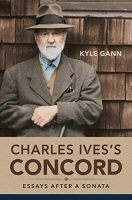
Music Book Review: Charles Ives's Concord: Essays After a Sonata by Kyle Gann

Charles Ives’s Concord: Essays After a Sonata

by Kyle Gann (Music 780.92 Ive)


2021 was the one of a few years that could be considered the centennial of Charles Ives’ Concord Sonata. The truth of this well-known piece is more complicated than most, as Ives revised it many times. The Concord Sonata is fascinating for many reasons, but I think it’s particularly notable in 20th century music in that it’s one of the most atonal pieces that is fairly well-received universally, even by audiences that don’t usually warm up to such music. I think one of the main reasons for that is that it’s somewhat “programmatic” music, rather than “absolute”: that is, each of its movements make reference to figures in the transcendentalist movement, and listeners can calibrate what they’re hearing through that kind of interpretive filter. That frame of reference, plus the notion that Ives distributed a sort of book with the early editions of the piece entitled “Essays Before a Sonata,” gave listeners some extramusical considerations to grasp onto while appreciating the music.


We have a great book that attempts to unravel the many mysteries of Ives’s Piano Sonata No. 2, more commonly known as the Concord Sonata, that you can borrow from Polley. It’s called Charles Ives’s Concord: Essays After a Sonata by composer and long-time music journalist Kyle Gann, and you’ll learn more about both this piece and Ives more generally than you ever thought possible in these pages. I should start off with a bit of a caveat, though: this is the kind of book that you’ll get the maximum benefit from if you read music notation. There’s a lot of material here that you’ll be able to get through just fine if you don’t, but Gann attempts to untangle the complexities of this this piece from both historical and musical perspectives. That means there are sections of more formal musical analysis sprinkled throughout the book.


That issue aside, and I’m guessing that there’s probably a pretty significant overlap between music readers and Ives fans, anyway, this book is just a phenomenally deep take on the Concord Sonata. The first chapter, although relatively brief, lays out more than I’ve ever seen elsewhere about the origins of the piece, and Ives’ stature around that time of his life. I imagine many of us have heard tall tales around Ives, this notion of a person who led a very serious kind of double life as an insurance salesman by day and composer by night, approaching music in totally unique ways that most of the world didn’t even begin to catch up to until the 1960s, and toiling away at this music that remained mostly unknown and unplayed. It turns out that while elements of that picture are accurate, some of the details might change the way you conceptualize where he was coming from. Take his job as an insurance salesman, for example: I guess in my mind I had always pictured that meaning that he’s a kind of blue collar worker, low on the corporate totem pole, and I don’t recall going over any details to the contrary in music school. In reality, Gann points out that “By 1921, he was quite a wealthy businessman, in the top 1 percent by fortune.” It’s quite true that only a few people knew that he spent all of his spare time composing music, though. But his wealth and status in the insurance industry certainly explains how he was able to self-publish many of his works, and mail them out to people who he thought might be interested in them.


The Concord Sonata was one such piece. Gann reports that there is evidence of him starting to work on it dating back to 1911, starting to perform parts of it for people by 1915, and in 1919, he had prepared a version of the piece that he paid music publisher G. Shirmer to print 750 copies of. He additionally printed an accompanying set of essays, called “Essays Before a Sonata,” and in 1921, he mailed hundreds of copies of the piece to a list of music-related figures whom he thought might be able to further advance his work. It’s worth noting that he underwent a similar self-publishing and mailing campaign in 1922 for his “114 Songs.” He chose his recipients of these materials from a subscription list for the Musical Courier and Who’s Who in America. He found few sympathetic recipients this way, though the piece did find its way to several pianists who played portions of the Sonata publicly as early as 1921 and a full performance around 1927. Then Ives continued to revise the piece in the ensuing decades, publishing what’s now considered to be a more definitive version in 1947.


The next chapter is devoted to Ives’ Essays Before a Sonata, in which Gann immediately challenges another commonly-held assumption about the written work accompanying the music. It’s often been said that Ives was somewhat careless with the quotations he leverages throughout his essays to make his points, but Gann has found that his quotations are in fact quite accurate. He includes an appendix that further delineates this issue. The main focus of the chapter, however, is simply reflecting on how novel it was for Ives to create this kind of preparatory literary work for his music, and how unusual it was at the time for programmatic instrumental music of this kind to be made.


These chapters are brief but very informative, and then the bulk of the book is spent approaching the Concord Sonata musically from a few different angles: movement by movement, across the whole piece, and looking into how some material appeared in other Ives compositions. Again, music readers will get the maximum benefit out of this analysis, but I would still encourage you to read on if you’re interested in Ives. Each movement of the Concord is considered from so many perspectives, including Ives’ essays about the piece, that you’ll still find a lot of revealing insights here. And in these sections, you’ll find all kinds of fascinating approaches Ives used that were quite unusual for their time. For example, even from the beginning of the piece, the main theme of the Sonata, often referred to as the “Human Faith” theme, is obscured, coming into focus later. Ives has noted that he wanted themes to coalesce out of their own development, rather than the more traditional method of stating them first and then having variations spin off. Then Ives draws from his set of idiosyncratic approaches, using things like bi-tonality, quotations from other familiar classical and folk music pieces, and occasionally implementing things that are now called “extended technique,” like using a board on the piano keys to perform large clusters of notes.


Most of the analysis is done using the 1947 version of the Concord. Toward the end, Gann does a brief comparison of some of the differences between the earlier version printed in 1920 and the 1947 edition. It’s remarkable that Ives continued to refine this piece for so much of his life. Clearly it was of deep significance to him, and even though he ceased to write new music in 1927, he devoted a lot of time to making the Concord the best it could be.


(If you enjoy this, you may also wish to try Charles Ives and His World by Peter J. Burkholder or Charles Ives: A Life With Music by Jan Swafford.)


( official Jan Swafford web site )


Recommended by Scott S.
Polley Music Library


Have you read or listened to this one? What did you think? Did you find this review helpful?


New reviews appear every month on the Staff Recommendations page of the BookGuide website. You can visit that page to see them all, or watch them appear here in the BookGuide Blog individually over the course of the entire month. Click the tag for the reviewer's name to see more of this reviewer’s recommendations!


Check out this, and all the other great music resources, at the Polley Music Library, located on the 2nd floor of the Bennett Martin Public Library at 14th & "N" St. in downtown Lincoln. You'll find biographies of musicians, books about music history, instructional books, sheet music, CDs, music-related magazines, and much more. Also check out Polley Music Library Picks, the Polley Music Library's e-mail newsletter, and follow them on Facebook!


Friday, December 17, 2021

Music Book Review: Arcana X: Musicians on Music, edited by John Zorn

Arcana 10: Musicians on Music

by John Zorn (Music 780.904 Arc V. 10)


In editor John Zorn’s preface to Arcana X, it becomes clear that he considers this 10th volume in the series to be the final volume. As a reader since the first Arcana was published in 2000, I’m bummed to hear that we’ve reached the end of this series, but incredibly grateful for the journey. If I had to choose one set of books in the Polley Music Library that have had the greatest impact on my own musical thinking and work, it would be the Arcana series.


Like all of the Arcana books, this is a collection of essays written by contemporary working musicians across a wide range of musical backgrounds. The topics and styles of each essay can vary widely — some talk specifically about their own musical practices or influences in a straightforward manner, others take philosophical, poetic, or academic approaches, and others are downright playful, creating theatrical skits to illustrate their ideas. My favorite thing about all of these books is that you’re likely to read about some artists you already know, but you’re just as likely to read about some new-to-you artists that you’re sure to love. For me, I was delighted to read composer Charlie Looker’s intense philosophical considerations toward using melismatic passages in his music, a touching autobiographical recap from legendary drummer Dave Lombardo, and an inspiring discussion of the pedal steel guitar and its unusual quirks by Susan Alcorn, among other great essays. And new-to-me artists in this volume include composer/trombonist Alex Paxton and young composer Ben Coniguliaro, both of whose music seems to have a certain resonance with their writing styles.


Most of the essays in this final volume were written during the pandemic conditions of 2020, so some artists were pursuing ideas they’d never had the time to consider in their usual rushed schedules as professional musicians. Composer David Hertzberg writes of developing a new relationship with the recordings of John Coltrane, for example, and violinist Stefan Jackiw details his time thinking about and playing through sections of Beethoven’s Violin Concerto. Perhaps my favorite essay here is by German composer Ulrich Krieger, who writes convincingly about our current moment in music history as being on the cusp of an unprecedented transition toward freer and fuller musical futures. But you really can’t go wrong reading anything in Arcana X — in a period of uncertainty, the optimism and dedication of all of these artists is a reward unto itself for readers.


Like the other volumes in the series, the main essay section is followed by short biographies for each contributor and recommended listening lists for each. My advice: read the essays, and if someone especially captures your imagination, flip to the back and track down some examples of their music from the listening list. If you’re like me, you’ll find yourself repeating this process many times, and your own listening and music-making will become all the better for it.


(If you enjoy this, you may also wish to try Arcana: Musicians on Music, Arcana volume II and Arcana Volume IX, all edited by John Zorn.)


( official Tzadik – John Zorn web site )


Recommended by Scott S.
Polley Music Library

Have you read or listened to this one? What did you think? Did you find this review helpful?


New reviews appear every month on the Staff Recommendations page of the BookGuide website. You can visit that page to see them all, or watch them appear here in the BookGuide Blog individually over the course of the entire month. Click the tag for the reviewer's name to see more of this reviewer’s recommendations!

Check out this, and all the other great music resources, at the Polley Music Library, located on the 2nd floor of the Bennett Martin Public Library at 14th & "N" St. in downtown Lincoln. You'll find biographies of musicians, books about music history, instructional books, sheet music, CDs, music-related magazines, and much more. Also check out Polley Music Library Picks, the Polley Music Library's e-mail newsletter, and follow them on Facebook!


Monday, May 31, 2021

Book Review: Dream Catchers, POPS the Club Anthology, edited by Amy Friedman

Dream Catchers, POPS the Club Anthology

by Amy Friedman (and others) (YA PB (Non-Fiction) Friedman)


In the United States mothers and fathers go to prison at troubling rates. One of every 12 American children, more than 5.7 million kids under age 18, have experienced parental incarceration at some point during their lives. (https://www.sentencingproject.org/publications/6148/) It’s an issue that hadn’t crossed my radar until I picked up Dream Catchers, POPS the Club Anthology. I was attracted to the essays because of my interest in first person views of the childhood experience.


The authors, poets and artists in this anthology have parents or family that are incarcerated and they are striving to find their own ways to deal with this pain in their lives. They share their resilience and wisdom through pieces about navigating change and overcoming adversity.


One of my favorite essays is by John Rodriguez, who shares how he feels when slips out of his house at night and how his art is an escape from the negative factors in his world. Another favorite is by Julian Izaguirre, who invites us to paint our own version of his life, and challenges us to use the tools he’s been given to paint a different picture than what we assume. The poem Visiting Day by Kei’Arri McGruder, is poignant and heartbreaking. So many of these pieces deserve deep consideration. We often assume that childhood is carefree, when in reality so many children are experiencing things that are nearly impossible to fathom.


Dream Catchers is the seventh volume produced by POPS clubs. It is a fascinating lens into the lives of teenagers with incarcerated parents. As with any compilation of material by teenagers, there’s a range of polish in the works, but the depth of feeling is consistent all the way through.


For more information on POPS Clubs: https://popsclubs.org/.


[ publisher’s official Dream Catchers web page ]


Recommended by Carrie K.
Bennett Martin Public Library — Public Service


Have you read or listened to this one? What did you think? Did you find this review helpful?


New reviews appear every month on the Staff Recommendations page of the BookGuide website. You can visit that page to see them all, or watch them appear here in the BookGuide Blog individually over the course of the entire month. Click the tag for the reviewer's name to see more of this reviewer’s recommendations!

Sunday, July 26, 2020

Book Review: How I Resist: Activism and Hope for a New Generation edited by Maureen Johnson


How I Resist: Activism and Hope for a New Generation
edited by Maureen Johnson (YA PB (Non-Fiction) Johnson)

Living in an era in which more and more people are becoming activists in one way or another, I’ll admit this book caught my eye on one of the libraries’ “new books” displays, and I enjoyed browsing through it enough to check it out.

How I Resist is a relatively quick, easy read. Editor Maureen Johnson has assembled a collection of 29 essays, interviews, poems and/or cartoon selections, by a wide and diverse group of contributors. All take on the themes of “how to resist the status quo — how to make a difference — how to “matter” in today’s world of news churn, social media obsessions, fractured interpersonal relationships and hostile political separatism. Contributions come from writers, actors, musicians, poets, artists and people from across a wide social spectrum. Many are individuals I was not familiar with, while others are best-selling personalities like authors Rebecca Roanhorse, Libba Bray, Jennifer Weiner and Jacqueline Woodson. Each has a unique perspective, and while many offer variations on the concept of “Don’t give up — keep trying — just by trying you’re making an impact”, several of them have very precise and constructive advice on being a modern day activist.

Definitely worth sampling!

[ publisher’s official How I Resist web site ] | [ official Maureen Johnson web site ]

Recommended by Scott C.
Bennett Martin Public Library – Public Service

Have you read this one? What did you think? Did you find this review helpful?

New reviews appear every month on the Staff Recommendations page of the BookGuide website. You can visit that page to see them all, or watch them appear here in the BookGuide Blog individually over the course of the entire month. Click the tag for the reviewer's name to see more of this reviewer’s recommendations!